Patan
The Tigers of MompracemPatan is one of Sandokan’s captains and a skilled cannoneer whose role in the pirates’ battles is defined by command, accuracy, and persistence. He first appears as the leader of a crew of fifty; later, his cannon fire helps damage an opposing junk and strikes the British cruiser at Labuan. In the latter battle, he remains at his post and is killed there, after which another gunner takes his place. His brief but consequential trajectory links the orderly assignment of a crew to the costly continuation of combat.
Identity and Command
When Sandokan summons him, Patan steps forward as a tall, muscular Malay dressed in a simple red chawat. His rolling gait is described as characteristic of men of the sea, marking him within the maritime world the pirates inhabit. The introduction gives him a physical presence without furnishing a personal history: his identity in the narrative is established through his position among Sandokan’s captains and his subsequent work at the cannon.
Sandokan asks how many men are in Patan’s crew, and Patan answers that there are fifty. When asked whether they are good warriors, he says they are all eager for battle. The exchange presents him as the spokesman for a substantial fighting unit, not merely an individual fighter. Sandokan’s summons and questions place Patan within a chain of command, while the crew’s readiness establishes the force he brings to the expedition. The scene also contrasts the captain’s affectionate attention to his men with the practical business of counting the fighters and assessing their capacity.
Engagement with the Junk
During the attack on the junk, Patan’s artillery makes a direct and visible difference to the course of the encounter. After a small-calibre cannonball passes through the prahu’s sails, Patan aims and fires his own cannon. His shot splits the junk’s mainmast at its base. The mast then falls onto the deck, bringing sails and rigging down with it. The opposing crew runs along the bulwarks and disappears from view as the pirates watch.
The episode establishes Patan’s effectiveness through a specific result rather than through a general claim of courage: one well-placed shot disables the junk’s principal mast and disrupts its working sails and rigging. It also foreshadows the function he will serve in the later, more unequal fight. Patan is repeatedly positioned where cannon fire can alter the opposing vessel’s capacity to maneuver or respond; his skill is part of how the pirates contest stronger ships, not simply a mark of personal distinction.
The British Cruiser Battle
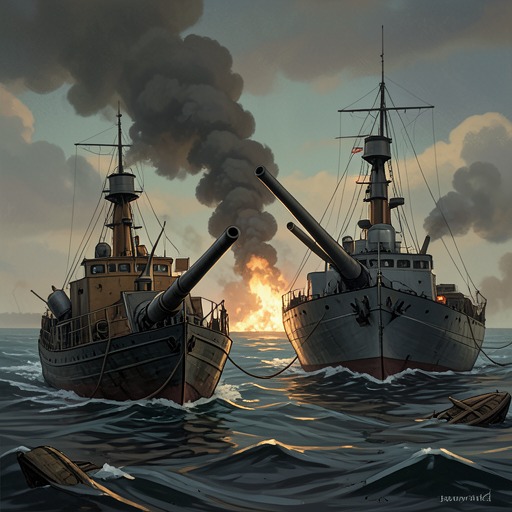
When the British cruiser at Labuan fires toward the prahus, Sandokan calls on Patan to man his cannon. The narration identifies him as one of the finest cannoneers to have operated in those waters. Patan fires, and the shell smashes through the enemy bridge’s gangway while also snapping the flagpole in two. The hit damages a prominent part of the warship, but it does not end the engagement: instead of immediately returning fire, the cruiser turns to present its port gun ports, where several cannons are positioned.
Sandokan then directs Patan to make every shot count and to target the cruiser’s masts and wheel. The command stresses the tactical stakes of Patan’s precision: the pirates need to impair the larger ship’s movement and control while remaining exposed to its guns. The battle develops into a sustained exchange. Thick smoke makes it difficult for the crews to find their marks, yet the artillery continues to thunder. The two pirate vessels, though outmatched, keep firing rather than yield, and their aim of reaching the enemy bridge remains beyond them as the cruiser eventually withdraws farther away to avoid being boarded.
Death and Narrative Role
Patan does not leave his cannon during the battle. The account states that he is killed while stationed there, and that another capable gunner takes his place. This brief report closes the arc established by Sandokan’s earlier command: Patan’s post is both the source of his battlefield importance and the place where he dies. The replacement keeps the cannon in action, making the loss personal and tactical at once; the crew’s work continues, but it must continue without the captain who had fired so effectively.
Patan’s scenes give the larger action a concrete measure of what the pirates’ refusal to retreat costs. His first cannon shot brings down a mast; in the later engagement, his successful hit on the cruiser’s bridge and flagpole cannot prevent the fight from turning against the prahus. The contrast is not between skill and incompetence—Patan is explicitly presented as an exceptional gunner—but between a capable fighter’s precise contribution and the greater force arrayed against the pirates. His death at his station makes that imbalance visible through the loss of one of the men sustaining their attack.